
News
-
Paper-Presentation at ICIIS 2025
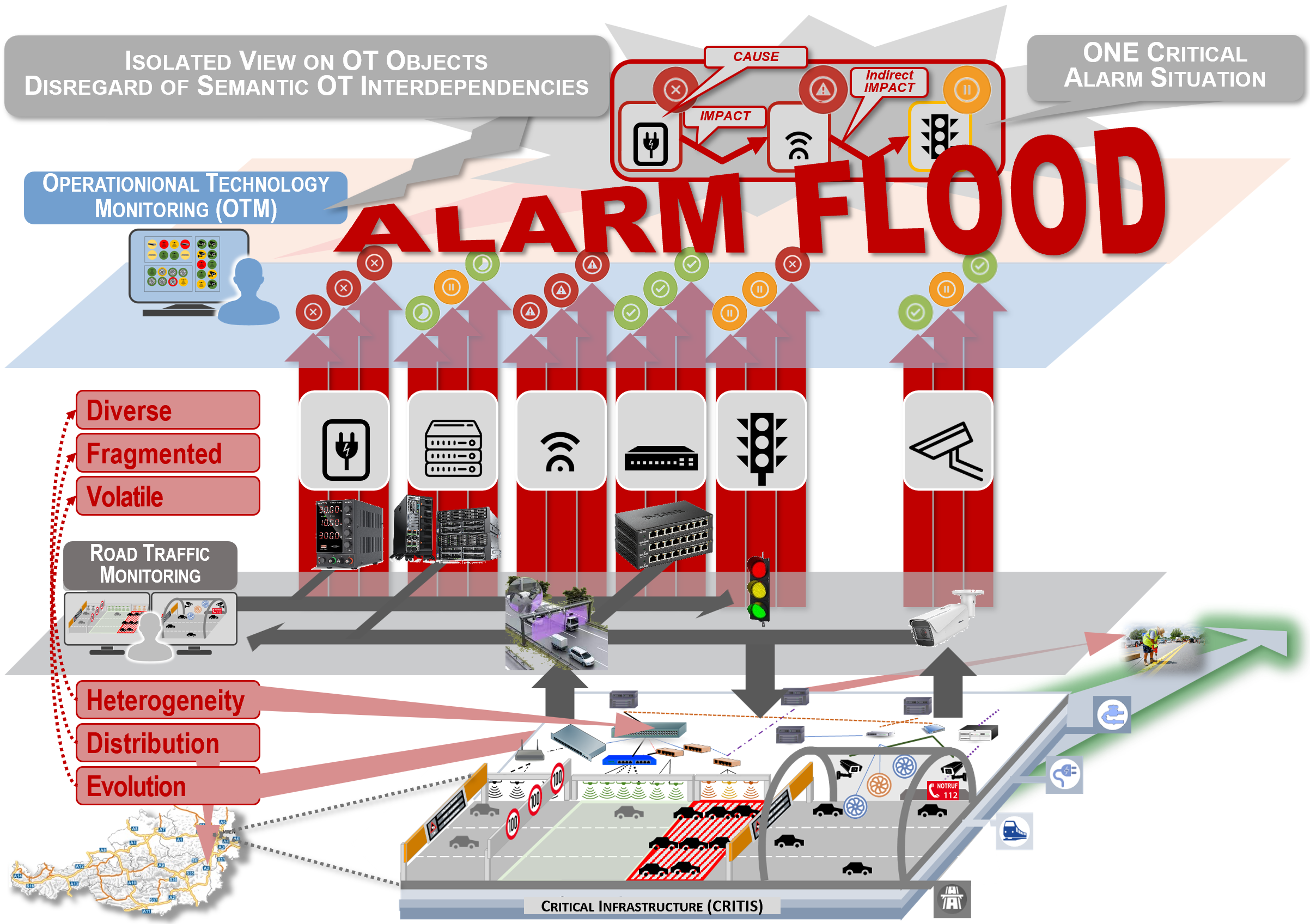
Our colleague Wieland Schwinger attended the International Conference on Industrial and Intelligent Information Systems (ICIIS), where he presented the paper “Alarm Flood Reduction in Critical Infrastructures – Research Roadmap & Preliminary Results”. The contribution reports on ongoing research conducted in the context of the iReduce project.
Critical infrastructures such as energy or traffic systems rely heavily on operational technology (OT) and generate a continuous stream of alarms. In practice, operators are often confronted with alarm floods that obscure truly critical situations and significantly hinder timely, safety-relevant decision making. This challenge is exacerbated by typical characteristics of critical infrastructures, including heterogeneous OT systems, wide geographical distribution, decentralized operation, and continuous system evolution.
The presented work addresses the problem of alarm flood reduction by explicitly considering interdependencies between OT components. It outlines a research roadmap that follows a two-step approach to identify, represent, and exploit such interdependencies. Central to this approach is a domain-adaptable OT knowledge base for semantic representation, complemented by provenance mechanisms to cope with system evolution over time.
In addition to the conceptual roadmap, the presentation reported on the current implementation status and first evaluation results of the iReduce framework. These results demonstrate the potential of systematically exploring OT interdependencies as a key enabler for intelligent alarm reduction in critical infrastructures.
-
Paper Presentation at ITSC 2025
Our colleague David Graf presented the paper “Alert-Driven Pattern Mining in Large-Scale Road Traffic Management” at the IEEE Intelligent Transportation Systems Conference (ITSC 2025). The contribution addresses a long-standing challenge in the operation of large-scale control systems, with a particular focus on road traffic management.
Modern road traffic management systems continuously generate immense volumes of alerts, confronting operators with alert floods that significantly impede safe and efficient system operation. While alert reduction has been studied for decades, identifying meaningful alert patterns remains particularly difficult due to the heterogeneity, scale, and continuous evolution of such systems. As a result, relationships between alerts often remain implicit and cannot be effectively exploited.
The presented work introduces an alert-driven pattern mining approach based on a hybrid, multi-objective evolutionary algorithm. The approach explicitly targets two complementary objectives. First, pattern coverage is maximized to ensure that every alert occurrence is explained by at least one pattern, enabling comprehensive reasoning over the entire alert log. Second, pattern frequency is leveraged to identify both frequent and rare patterns, thereby supporting alert flood reduction not only in routine situations but also in exceptional and potentially critical cases.
The applicability of the approach was demonstrated using real-world log data from large-scale road traffic management systems. In addition, a comparative evaluation highlights the effectiveness of the proposed method and underlines its potential as a key building block for intelligent alert management in complex transportation infrastructures.