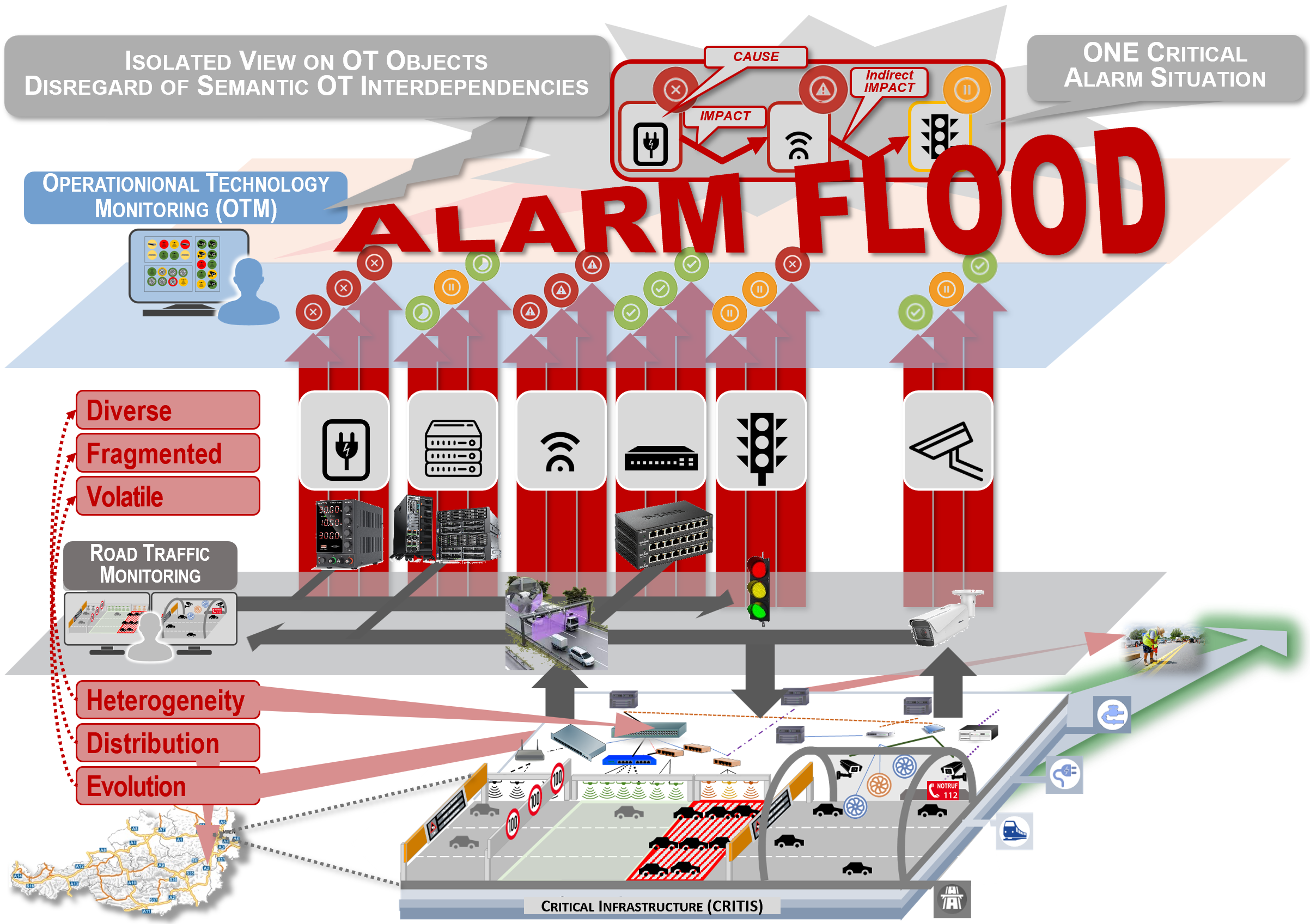
The immense flood of messages that is constantly produced by omnipresent monitoring and control technologies (aka. Operational Technology, OT) in critical infrastructures (CIs), ranging from Energy and IKT to traffic, represents a substantial challenge for efficient and safe operation. For example, in the course of traffic monitoring and control on Austria's highways, stretching 2,249 km and covering 166 tunnels, more than 10,000 messages are generated per hour even in "normal operation", with this flood of messages multiplying in exceptional situations due to vast numbers of (alarm) messages (henceforth "alarm flood"). These challenges are further exacerbated by CI-inherent properties such as heterogeneity, decentralization, and evolution. This inevitably leads to an isolated view, i.e., one that focuses exclusively on individual OT objects (e.g., sensors/actors), since the mutual dependencies between OT objects ("OT interdependencies") and their semantics are generally often neither known nor capable of being processed by machines. This hampers an intelligent processing of the alarm flood and subsequently to reduce it, so that human operators are confronted with the challenging task of manually identifying and assessing critical situations under time pressure, ultimately being able to make decisions that save lives and the environment.
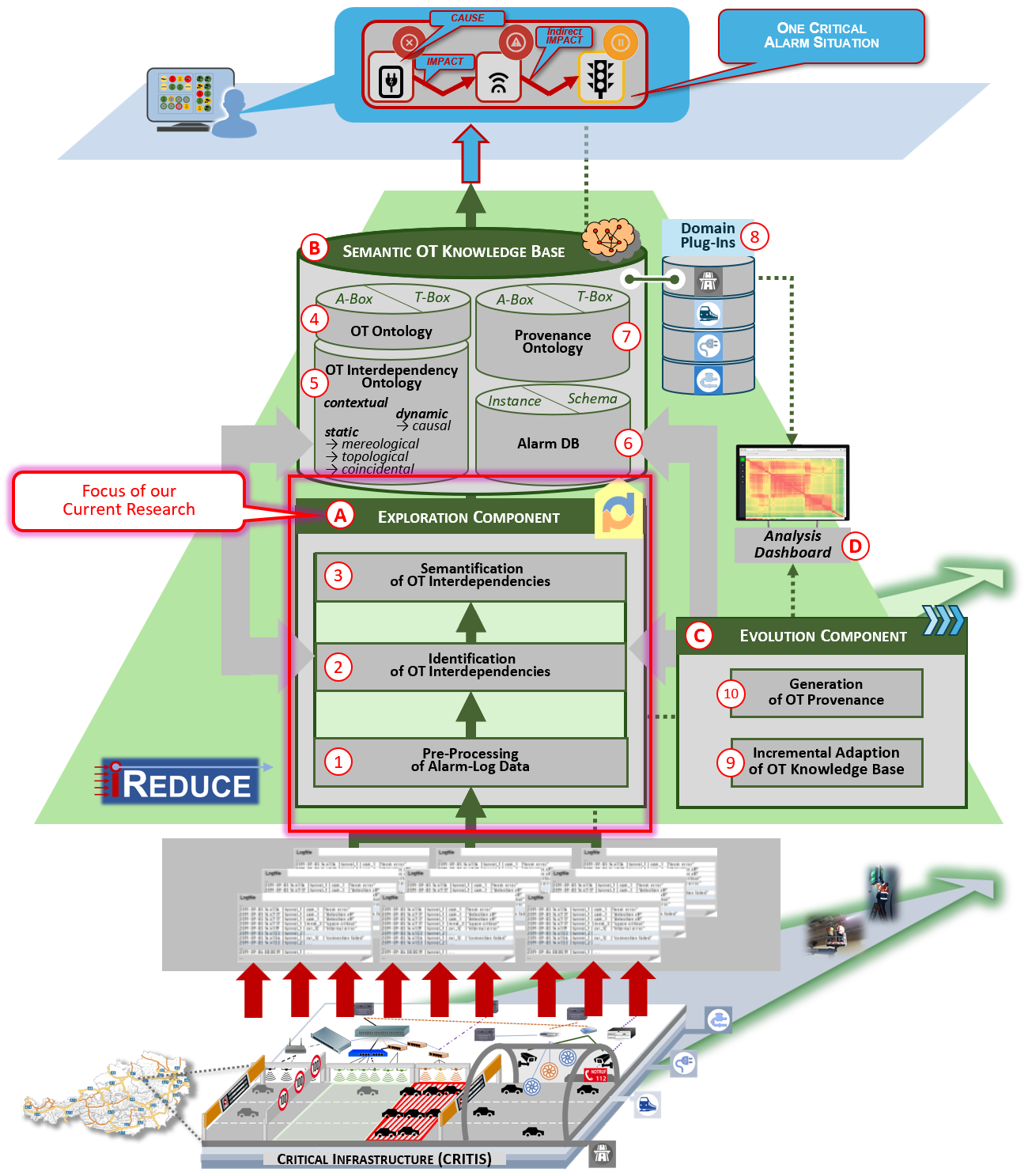
The »iReduce« project addresses these central challenges by realizing basic technologies for the exploration of semantic OT interdependencies, which form the core building block for intelligent alarm management in CIs and thus enable a continuous and dynamic reduction of alarm floods. This creates the basis for comprehensively counteracting the central challenges of efficient and safe CI operation due to the current alarm floods and to provide human operators with adequate and sustainable support in their day-to-day business, and, above all, in exceptional situations.
As a central result, functional core components will be implemented as practical show cases for the CI domain of traffic monitoring and control, completed by research into the conceptual requirements and technical prerequisites as well as a corresponding business model for their exploitation in CIs. In particular, »iReduce« is intended to put forward appropriate generic concepts to enhance their possible applicability to related KRITIS domains in order to take a step towards the vision of a sustainable and comprehensive strengthening of CIs in general.
The methodological approach follows the "Human Centered Design Process" in which the project result is continuously concretized bythe involvement of end users, ensuring sustainability and adequate evaluation in cooperation with demand carriers (some associated via LoIs) and companies from different CI domains. The interdisciplinary consortium combines a wide range of competencies from business and science with the applied knowledge of CI demand carriers, but in particular also from human operators who act as need providers and idea/solution providers.
The consortium of »iReduce« includes four scientific partners (Johannes Kepler University Linz (JKU) as consortium leader, University of Applied Sciences, Campus Hagenberg, Art University Linz), two business partners (team Technology Management GmbH, cloudflight) and the demand carrier ASFINAG.
For further information, please contact: Assoz.Univ.-Prof. Mag. Dr. Wieland Schwinger, JKU, wieland.schwinger@jku.at